
Most office cleaning is bought as a commodity and delivered as one. A price per month, a vague promise to clean the office, and a service that is excellent in month one and mediocre by month six. Nobody decides to let it slide. It slides because nothing was built to stop it.
Three things separate a contract that holds its standard from one that quietly decays. None of them are about working harder, and none of them cost much. They are structural.
Pillar one: scheduling built on how the building is actually used
The default in this industry is to treat a building as one uniform space and do roughly everything, everywhere, every visit. It sounds thorough. In practice it wastes most of the labor on areas that did not need it and starves the few that did.
A building should be zoned by use, not by floor plan. In a typical professional office that means roughly three tiers:
- Daily. Restrooms, the break room, the entrance and lobby, and the high-touch surfaces. These are driven by occupancy, so they need attention every visit regardless of how they look.
- Weekly or twice weekly. Private offices, conference rooms, low-traffic corridors, interior glass. Rooms that are used but not heavily, where the work is real but does not compound daily.
- Periodic. Carpet extraction, hard-floor treatment, high dusting, vents, window interiors, upholstery. Scheduled on a calendar months ahead, quoted separately, and the first thing to disappear from a contract nobody is managing.
How that zoning falls depends on your layout, and five common office layouts each need a different split. Zoning is also what lets a quote be honest. When frequency is assigned per area rather than per building, you can see what you are buying and drop anything that is not earning its place. A conference room used twice a month does not need a nightly visit, and saying so out loud is how a cleaning company demonstrates it is thinking about your building rather than its own invoice.
Everything, everywhere, every night is not thoroughness. It is the absence of a plan.
Pillar two: precision, which is mostly technique
The gap between a competent clean and an excellent one is rarely the products. It is a handful of procedures that either happen or do not, and none of them are visible to you at the time.
- Contact time on disinfectants. The surface has to stay visibly wet for the period printed on the label. Spray and immediate wipe does not disinfect anything; it leaves residue and a false sense of safety.
- Correct dilution. Concentrates are engineered for a ratio. Over-dosing leaves a film that attracts soil faster, which is why some offices never look clean no matter how often they are cleaned.
- Sequence. Top to bottom and dry before wet. Cleaning in the wrong order means re-contaminating surfaces you already finished, so the same hours produce a worse result.
- Color-coded microfiber. Separate cloths for restrooms, kitchens and general surfaces, so nothing travels from a toilet to a break room counter. Microfiber also lifts and traps soil rather than redistributing it the way cotton does.
- Real vacuum filtration. A vacuum without proper filtration collects the large debris and exhausts the fine particulate straight back into the air of a room your staff will occupy in the morning.
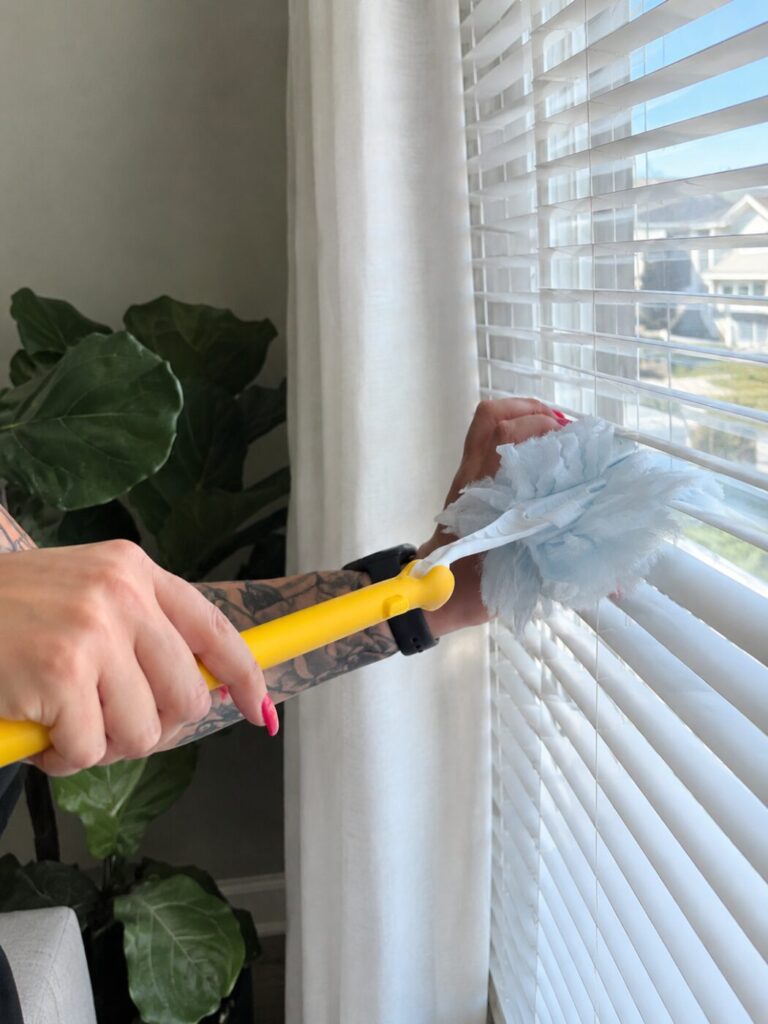
This is also where the difference between tidy and clean lives. Tidy is what a space looks like. Clean is what is no longer on the surfaces. An office can be immaculately tidy and genuinely dirty, and most people cannot tell the two apart by looking, which is precisely why the procedure has to be the guarantee.
The one that matters most
Pillar three: accountability you can actually see
Scheduling and technique both decay without this one. If nobody checks, quality drifts, and the drift is invisible until it is bad enough that you are already thinking about replacing the company.
Accountability in a small-office contract does not mean a dashboard. It means four concrete things:
What accountability looks like in practice
- A written scope. Every task with its frequency, agreed before the first visit. Without it there is no standard to fall short of, and every disagreement becomes opinion against opinion.
- Inspections on a rotation. A supervisor who physically checks the work against that scope, including the quiet months. This is the mechanism that catches drift before you do.
- A logged issue with a response time. When something is missed it gets recorded and remedied on a stated clock, not mentioned in passing and forgotten. Ours is a re-clean within 24 hours.
- A named contact who is not the cleaner. Someone at the office to call, so raising a problem never means confronting the person standing in your workplace.
The pattern to watch for is a recurring issue that keeps being fixed and keeps returning. A one-off miss is a person having a bad night. The same miss three times is a scope or a training problem, and it will not resolve itself no matter how many times it is apologized for.
Cleaning as maintenance of an asset
The part most businesses underrate is that commercial cleaning is not housekeeping. It is maintenance of physical assets you have already paid for.
Commercial carpet fails from abrasion, not from looking dirty. Grit tracked in from the parking lot works into the pile and cuts the fibers every time someone walks over it, and that damage is permanent. Regular vacuuming with real filtration plus periodic extraction removes the grit before it does the cutting. Skip it and you do not get a dirty carpet, you get a carpet that needs replacing years early, at a cost that dwarfs what the cleaning would have been.
The same logic applies to hard floors, where the finish is a sacrificial layer that is supposed to be maintained rather than stripped back to bare substrate, and to fixtures, where hard-water scale left to build eventually etches the surface underneath permanently.
In Harford County there are two local accelerants worth planning around. Road salt and grit from December through March are the worst thing that happens to commercial flooring here, and a proper entrance matting run plus tighter winter vacuuming is the cheapest protection available. Then spring pollen loads carpet, upholstery and HVAC returns heavily enough that many offices are better served tightening frequency in April and May than averaging it across the year.
How this gets set up
All three pillars are decided before the first visit, on site. Zoning needs somebody to see how your building is used, technique needs to be matched to your actual surfaces, and the scope that accountability depends on is written from what is found there. That visit is the walkthrough, it takes twenty to forty minutes, and it is where an honest number comes from.
We work with small offices and professional spaces across Bel Air, Aberdeen, Havre de Grace, Edgewood and the rest of the county, alongside our residential work. The standards are the same in both.
Frequently asked questions
What makes professional office cleaning different from a general cleaner?
A written scope with frequencies, supervised technique, and someone checking the work against that scope. Without those three, you are buying somebody’s best effort rather than a standard.
Does every area of my office need cleaning every visit?
No, and paying for that is usually waste. Restrooms, break rooms, entrances and high-touch surfaces are daily. Private offices and conference rooms are typically weekly. Deep work such as carpet extraction is periodic and quoted separately.
Do you clean outside business hours?
Yes. Most commercial work is scheduled after close or before opening so nothing interrupts your staff or your customers.
How do I know the work is being done properly?
A supervisor inspects against the written scope on a rotation, and anything missed is logged and re-cleaned within 24 hours. You also have a named contact at our office rather than only the technician in your building.
Who are your cleaners?
W-2 employees, company-trained and background-checked. No subcontractors and no third-party app labor, which matters in any building with restricted areas.
What size businesses do you work with?
Small offices and professional spaces across Harford County. If your facility needs a specialist we are not, we will say so on the walkthrough.
Harford County, MD
Set a standard your office keeps
A written scope, supervised technique, and someone whose job is to check. Book a walkthrough and we will show you what that looks like for your building.
Serving Bel Air, Aberdeen, Havre de Grace, Edgewood and all of Harford County.